
Sunday, May 4th, 2014
Homemade always seems to taste better than the stuff you buy at the store. It’s true with cookies, it’s true with pickles, and it’s definitely true with hummus.
Our new Hummus Meal Kit makes it easy for you to create a tasty, healthy snack that will impress all your party guests and might even encourage your kids to eat more vegetables!
The Hummus Meal Kit includes:
- Organic Garbanzo Beans (1 lb.)
- Garlic (1/4 lb.)
- Lemon (1)
- Recipe Card
The kit does NOT include olive oil, but you can always purchase Pons Organic Extra Virgin Olive Oil as a separate add-on. If you purchase a new bottle, you’re sure have plenty of quality Spanish olive oil left for stir-fries, pastas, and salad dressings!
Never made your own hummus before? Don’t worry! The kit includes a recipe card that walks you through each step of the process so you’ll be making hummus like a pro in no time.
Soaking the garbanzo beans Chickpeas boiled, prepping the other ingredients Ready to blend
Blended. Add olive oil to reach desired consistency Chips and dip
Looks good enough to eat!
Monday, April 21st, 2014
We want to make it easy for you and your family to prepare fresh, healthy meals every day – that’s why we bring organic fruits and vegetables directly to your doorstep!
In an effort to help you make the most of your box, we’re launching a series of Boston Organics Meal Kits that will help you save time and money.
This week, our Pasta with Tomato Sauce Meal Kit is available to all of our customers for purchase as an add-on!
The Pasta with Tomato Sauce Meal Kit includes:
- Organic Penne Pasta (16 oz.)
- Local & Organic Tomato Puree from Atlas Farm (28 oz.)
- Organic Onions (1/2 lb.)
- Garlic (1/4 lb.)
- Recipe Card
By adding just a few items from your weekly box, you can make a vibrant, healthy, and delicious meal for four. The recipe card recommends which vegetables to use and how to add them to your sauce! The Meal Kit is also available with whole wheat penne pasta.
Thursday, January 23rd, 2014
Don’t be fooled by the sunchoke—nothing is what it seems. With more names than the devil, sunchokes/Jerusalem artichokes/sunroots can intimidate those unfamiliar the scraggly root vegetable.
It looks like ginger, cooks like a potato, but tastes like an artichoke. Here’s a one-stop spot for answers on the root vegetable that is as delicious as it is deceptive.
What do you call it?
This shifty root veggie is often referred to as the Jerusalem artichoke, though it is neither native to the Middle East nor related to the artichoke family.
- The sunchoke is an edible tuber—the root of a prolific North American sunflower, Helianthus tuberosus. It seems that at some point in the sunchoke’s long history, the Italian word for sunflower, girasole, was corrupted into the word Jerusalem.
- Though it is botanically unrelated to the artichoke, its similar taste is likely the reason behind the shared name. Sunchokes are also commonly referred to as sunroots and earth apples.
- At Boston Organics we call this polyonymous root a sunchoke—a name that was created by produce suppliers in the 1960s when the obscure vegetable started to gain popularity.
Sunchokes are the tuberous root from the sunflower, Helianthus tuberosus. Photo credit: Bondesgaarde (Flickr)
How does it grow?
Watch out! The sunchoke is notoriously resilient and difficult to eradicate from a field once it takes hold.
- This tuber means business. It can tolerate hot weather and sub-zero temperatures. The first frost will kill the stems and leaves of the plant, but the tubers can survive in frozen soil for months.
- Conventional potato-harvesting machinery is unable to efficiently harvest the tubers on a commercial scale. Hand-digging has the largest percentage yields, but it is a laborious and expensive process. Livestock like to “root out” the tubers, and sunchokes were historically used to fatten cattle, sheep, and hogs.
- We primarily source our sunchokes through the Deep Root Organic Coop, a group of almost 20 small farms in northern Vermont and Southern Quebec.
Photo credit: Net_Efekt (Flickr)
How do you (and your body) store it?
Sneaky by nature, sunchokes are actually best stored underground as they rapidly lose moisture through their thin skin once they are dug up.
- Sunchokes can be stored for a few weeks in a cool, dry and well-ventilated area. If you need to store them in your refrigerator, wrap them in a paper towel and a sealed plastic bag before placing in the vegetable drawer.
- As expected, sunchokes are low in fat, but high in carbohydrates. They also have 3 grams of protein per 1 cup serving. Sunchokes are an excellent source of Thiamin and Iron and a good source of Phosphorus and Potassium.
- Unlike the starch in potatoes, which the body breaks down into glucose, this tuber stores energy in the form of inulin, which the body breaks down into fructose. This makes the sunchoke a good substitute root veggie for diabetics!
How can you cook it?
This extremely versatile root will slowly gain your trust and then – Bam! – you realize you want to add it to everything.
- Sunchokes can be steamed, boiled, grilled, fried, pickled, or microwaved. They can even be eaten raw!
- Renowned farm-to-table restaurateur, Odessa Piper, recommends mincing raw sunchokes and adding them to vinaigrettes like you would with garlic. She’s also been known to use sunchokes to thicken broths while delicately adding flavor.
- Before cooking, always scrub the nooks and crannies thoroughly. You can try to peel the gnarled root, but it’s not really necessary or worth the effort.
Recipes:
Don’t be fooled by the sunchoke. He may look twisted and grimy, but his taste and cooking utility is unparalleled. If you’re lucky enough to have captured some sunchokes, here are some recipes worth trying:
Thursday, May 23rd, 2013
The beginning of spring can be a difficult time for locavores and farmers alike. After eating through several months of root crops, we’re ready for something fresh and green! Luckily for us, the Northeast climate is perfect for growing asparagus, one of the first spring crops to become available.
Asparagus is a pretty cool plant. While many plants grow from a stock, vine, or branch, asparagus spears grow individually right out of the ground. Asparagus plants can set roots and live up to 20 years in one spot, producing edible shoots throughout their entire lifespan. We wish they were in season longer, but they’re only in season locally for the months of May and June each year.
Here at Boston Organics, we’re getting our spring asparagus fill from our good friends Laura and Rick Pedersen of Pedersen Farms in Seneca Castle, NY. Pedersen Farms has been in business for 30 years, growing both organic and conventional crops ranging from asparagus to grain.
We have been delighted to work with Pedersen Farms over the past several years to secure the first asparagus crop. It isn’t spring until we get a call from the Pedersens telling us the first asparagus harvest is ready!
Many of you will find this fresh asparagus in your box this week. You can also order it by the pound as an add-on for a limited time!
Once you’ve stocked up on these delicious shoots, check out our asparagus recipes and cooking tips.
We hope you enjoy the fresh flavors of spring!
Friday, April 5th, 2013
Next week we’re getting a special local crop from the fields of Winter Moon Farm – spring-dug organic parsnips! Unbelievably sweet and flavorful, these parsnips are a food-lover’s best friend.
You’re probably thinking with serious chagrin, “More parsnips?! But winter is over!” Winter may be over, but these are spring-dug parsnips – the cream of the crop!
What makes spring-dug parsnips special?
These are parsnips that were planted last spring and have been left in the ground over the winter to deep freeze. When parsnips are left in the ground throughout the winter, the extreme cold converts the starches into sugar and allows the parsnips’ flavor to mellow, giving way to a brilliant sweetness.
Never had parsnips? If you like carrots, you’re pretty much guaranteed to enjoy parsnips. Sweeter than carrots and more versatile, these parsnips become sweet, nutty, and succulent when cooked. Parsnips can be roasted or used in chowder, soups, and purees. You can even make parsnip wine!
We know many of you have parsnips on your No-List, but we want you to give these guys a try! There’s no better time to try ‘em, so we recommend taking them off your No-List just for a week to get a taste of this once-a-year treasure.
These parsnips will be fresh out of the ground next week, so make sure you update your accounts this weekend or you’ll miss out on this sweet spring treat!
What do you do with spring-dug parsnips?
1. Make Chowder
2. Fry them up into fritters
3. Make parsnip soup
4. Puff them up in a souffle
We hope you enjoy this sweet gift of the snow! Check out our Parsnip page for nutritional information, cooking tips, and more recipes!
Tuesday, March 12th, 2013
The Dogma Box includes produce sourced as close to Boston as possible. Similar to a CSA, this box is filled with the best organic produce from local and regional farms.
This week’s Dogma Box contains:
Stay warm and enjoy these local offerings.
Friday, January 11th, 2013
Visit 12/21/12
We try to make an effort to visit our local growers and vendors at least once a year, and a few weeks ago we took a trip out to our new organic milk supplier, Shaw Farm of Dracut, Massachusetts! Located just an hour north of our Charlestown office, this family-owned dairy farm is about as local as it gets for Boston. After tasting some of their legendary eggnog and other products, we’re tempted to make our visits more frequent.
Shaw Farm operates their own farm store with fresh milk, ice cream, and even baked goods. The farm store is heated by geothermal energy – a renewable energy created by the heat found below the earth’s surface. It not only helps with their energy bill, but it also reduces greenhouse gas emissions on the farm.
1. Story and history of Shaw Farm
Since 1908 Shaw Farm has been providing high quality local dairy products to the Merrimack Valley. Located in Dracut, MA, the farm offers fresh milk, ice cream, and many other local products. Their tagline – “if they say it’s homemade, ask to see their cows” – reminds us of the true farm-to-table process and begs us to ask the question where does our food come from?
2. Why did they start the organic brand?
In 2007 Shaw Farm began to market its own “certified organic” milk products under the name New England Organic Creamery. Owner, Warren Shaw says changes in the marketplace driven by consumer demand for local organic milk have made this change important to the future of the farm. He saw that there was a demand for organic milk and realized that the transition to become certified organic was fairly simple since the farm already operated under many of the organic standards. Now they are the only certified organic milk producer in Massachusetts.
On extremely rainy days the cows stay indoors to prevent slips in the field. These girls are staying dry in the dairy barn!
3. How are the cows fed?
Shaw Farm has 16 cows that make up the organic herd. The cows go out in the morning to graze on organic pasture and relax in the field during the day. The majority of the organic herd’s diet consists of organic grass from their pasture and is supplemented with organic grains. Three generations of Shaw’s take care of the 150 acres of nutrient rich orchard grasses that help give the cows their proper protein and fiber. Warren also explained that he has never used antibiotics, growth hormones or anything that might taint the organic milk or harm his cattle.
4. How does farm legislation affect the Shaw Farm business and operations?
The recent nine-month extension of the federal farm bill allowed Shaw Farm to avoid an immediate rise in conventional milk prices. We asked Warren how the farm bill and other dairy industry legislation might affect his business, and he explained that federal milk subsidies and regulations only impact dairy farms that belong to co-ops, not independent dairy farmers like himself.
Because of Shaw Farm’s proximity to the city and densely concentrated population, they have direct access to a large customer base and are able to provide dairy directly to customers and retailers, such as Boston Organics. Because of our collective support, Shaw Farm will be able to thrive, operate, and continue their environmental stewardship of the land that has been in the Shaw family for several generations.
Monday, January 7th, 2013
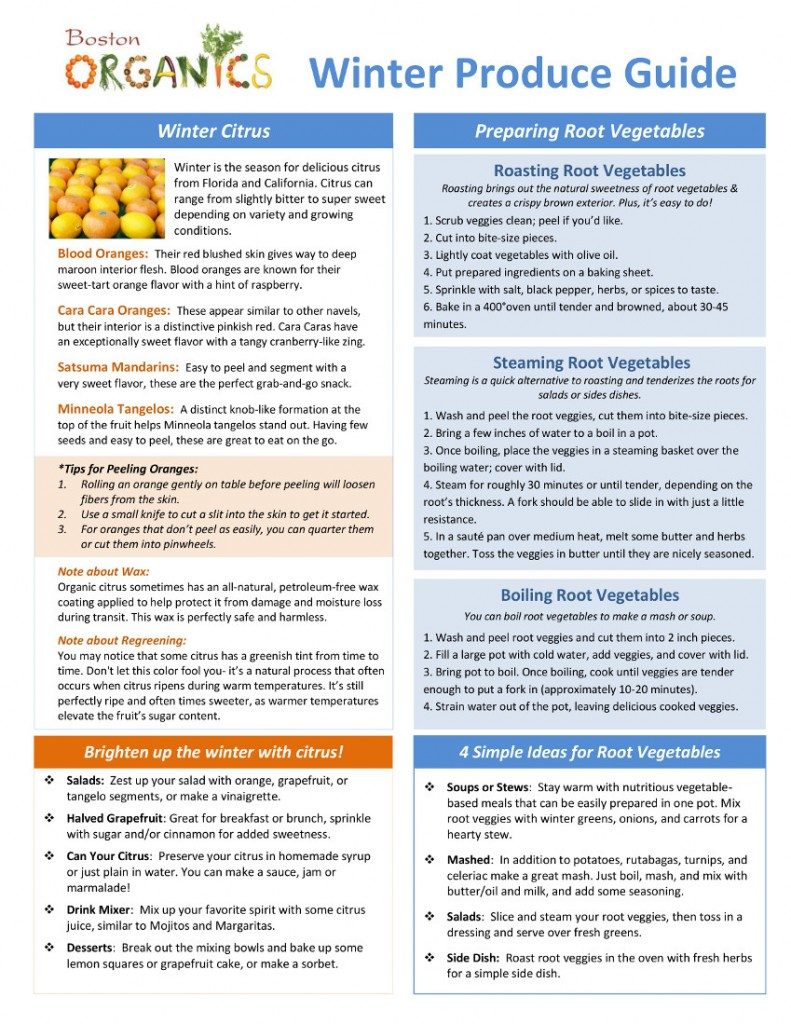
Winter produce is in full swing, and we want to help you make the most of this season’s bounty. We’re handing out a Winter Produce Guide with produce profiles, cooking tips, and recipes for some of the produce you’ll see in boxes this Winter. Check it out!
Monday, November 26th, 2012
What Happened with Prop 37 and Where Do We Go From Here?
As you have probably heard by now, Proposition 37 – California’s controversial ballot question requiring the mandatory labeling of GMOs – sputtered and stalled in the polls.
So what happened?
The proposition failed by a relatively small margin – 46.9 percent to 53.1 percent – leaving the bill motionless and many people upset. The big food industry heavily contributed to “No on 37,” an anti-labeling campaign that spent over $45 million, outspending the pro-labeling camp by roughly six to one. Their large budget facilitated the release of an aggressive advertising campaign which claimed that food prices for California families would increase by $400 per year, scaring uninformed Californians to vote no. We had been watching the Prop 37 debate closely, and like many people, felt wary about the results.
What does it mean?
Despite the proposition’s defeat, we believe we have reason to feel good about what happened this past Nov. 6th. We met with natural foods movement pioneer and Organic Valley Coop’s Mission Executive Theresa Marquez to discuss the current state of the organic industry and how we can move forward in advocating for greater food transparency. Theresa believes the sun will shine on the mandatory labeling campaign again.
The fact that GMO labeling was on the ballot in California, and brought millions of voters to the polls in support, was a success in and of itself. The media coverage has helped propel the issues of GMO policy, research, and transparency to the forefront of the nation’s attention. The press coverage has sparked new discussions, raised the public voice on the importance of knowing what is in their food, and will hopefully bring optimism to GMO labeling on the next ballot.
There is also word that Washington State is putting together a GMO labeling law that could be up for voting as early as 2013. We suspect other states will follow. The general sense of optimism is a great sign for the future; with hard working food activists like Theresa Marquez and educated voters at the polls, food reform can be possible.
What’s next?
There is still a lot of work to be done, and you don’t have to be in California or a well-known food pioneer to make a difference. Though GMOs are not currently labeled, there are other labels that can help you make better informed decisions at the grocery store.
- Because GMOs are not allowed in USDA certified organic products, buying certified organic is a 100% guarantee for GMO-free food. If you’re not sure where to start, people have found the Dirty Dozen list to be helpful in deciding which fruits and vegetables to start buying organic.
- Look for Non-GMO verified products.
Take Action!
1. Vote with your dollars. As sales of organic and non-GMO verified products increase, more businesses will be motivated to serve this growing market.
2. Sign petitions to let key decision-makers know that we want foods labeled if they contain GMOs!
- Just Label It
- Massachusetts petition to require labeling of GMO foods
3. Keep up with the conversation by following organizations that are working to improve GMO transparency:
- Our Right to Know
- Non-GMO Project
As a customer of Boston Organics, you can be sure that your food is free from synthetic chemical pesticides, herbicides, and GMOs. We only source 100% USDA and third party certified organic food for our boxes, and we will continue to make sure that the foods we provide for you and your family are safe, wholesome, and healthy.
Monday, November 26th, 2012
We hope everyone had a happy Thanksgiving holiday! We’ve got lots of great veggies this week along with some special fruits, including persimmons and Ataulfo mangoes! It’s also the last week for cranberries, and we still have some of our holiday produce and pecan add-ons for your cooking needs this holiday season. Check out the newsletter!