
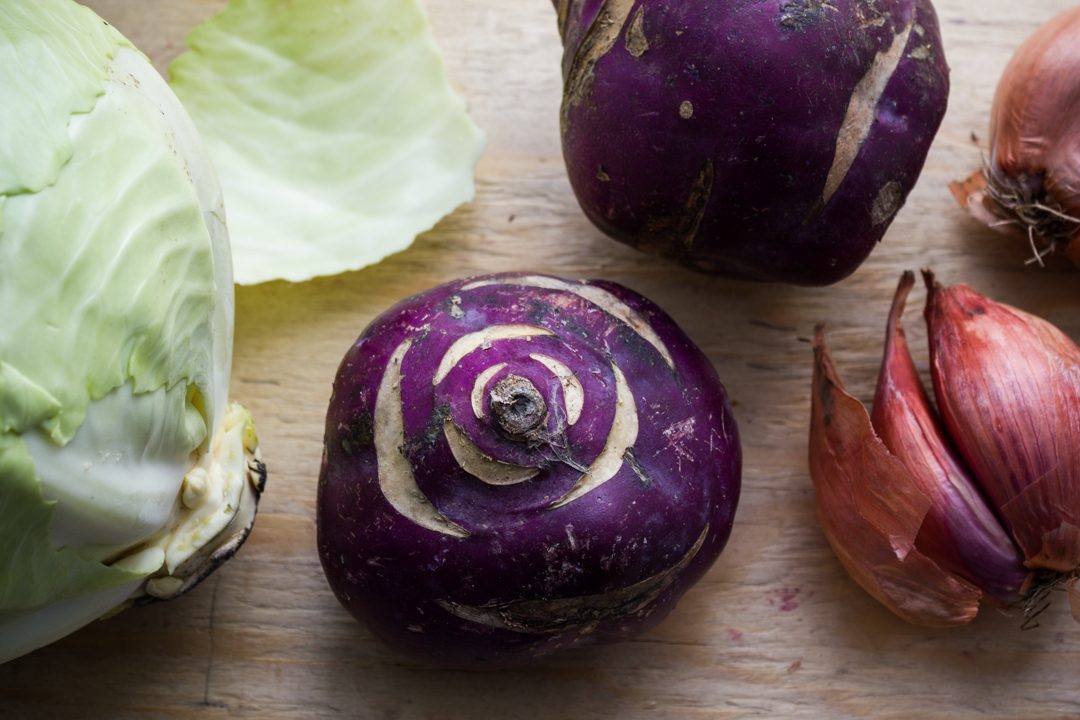
March is one of the most difficult months for Massachusetts locavores to find fresh organic fruits and vegetables. While California may already be showing early signs of spring, New England is still in the depths of winter.
Even the most prepared homesteaders are scrounging through the back shelves of their pantries to find the items they stored at the end of the last local season.
Fortunately, because Boston Organics works with a network of organic farmers, we’re able to continue to fill our boxes with a smattering of local produce by getting the best items from each farm.
This week, we have a profusion of organic root veggies like parsnips, potatoes and rutabagas. We also have a medley of fresh organic herbs from central Massachusetts!
Locavore Recipe of the Week
Polenta is one of the coziest dishes you can make in the wintertime.
Braised root vegetables provide an excellent topping for this baked polenta, with its deliciously crusty edges and gooey, cheesy center.
Slowly cooking your parsnips, carrots and kohlrabi helps draw out these roots’ natural sweetness and creates a buttery melt-in-your-mouth texture that will have everyone asking for seconds.
This Week’s Local Produce
Potatoes
Picadilly Farm
(Winchester, NH)
Rutabagas
All of the fruits and vegetables we deliver are grown without synthetic pesticides and are USDA certified organic. Interested in receiving produce that’s both organic and locally sourced all year round? Check out our Local Dogma Box.
Similar to a CSA or farm share, our Local Dogma Box is filled with the best organic produce from local and regional farms and brought right to your door each week. It’s the easiest way to eat like a locavore!
Don’t be fooled by the sunchoke—nothing is what it seems. With more names than the devil, sunchokes/Jerusalem artichokes/sunroots can intimidate those unfamiliar the scraggly root vegetable.
It looks like ginger, cooks like a potato, but tastes like an artichoke. Here’s a one-stop spot for answers on the root vegetable that is as delicious as it is deceptive.
What do you call it?
This shifty root veggie is often referred to as the Jerusalem artichoke, though it is neither native to the Middle East nor related to the artichoke family.
- The sunchoke is an edible tuber—the root of a prolific North American sunflower, Helianthus tuberosus. It seems that at some point in the sunchoke’s long history, the Italian word for sunflower, girasole, was corrupted into the word Jerusalem.
- Though it is botanically unrelated to the artichoke, its similar taste is likely the reason behind the shared name. Sunchokes are also commonly referred to as sunroots and earth apples.
- At Boston Organics we call this polyonymous root a sunchoke—a name that was created by produce suppliers in the 1960s when the obscure vegetable started to gain popularity.
Sunchokes are the tuberous root from the sunflower, Helianthus tuberosus. Photo credit: Bondesgaarde (Flickr)
How does it grow?
Watch out! The sunchoke is notoriously resilient and difficult to eradicate from a field once it takes hold.
- This tuber means business. It can tolerate hot weather and sub-zero temperatures. The first frost will kill the stems and leaves of the plant, but the tubers can survive in frozen soil for months.
- Conventional potato-harvesting machinery is unable to efficiently harvest the tubers on a commercial scale. Hand-digging has the largest percentage yields, but it is a laborious and expensive process. Livestock like to “root out” the tubers, and sunchokes were historically used to fatten cattle, sheep, and hogs.
- We primarily source our sunchokes through the Deep Root Organic Coop, a group of almost 20 small farms in northern Vermont and Southern Quebec.
Photo credit: Net_Efekt (Flickr)
How do you (and your body) store it?
Sneaky by nature, sunchokes are actually best stored underground as they rapidly lose moisture through their thin skin once they are dug up.
- Sunchokes can be stored for a few weeks in a cool, dry and well-ventilated area. If you need to store them in your refrigerator, wrap them in a paper towel and a sealed plastic bag before placing in the vegetable drawer.
- As expected, sunchokes are low in fat, but high in carbohydrates. They also have 3 grams of protein per 1 cup serving. Sunchokes are an excellent source of Thiamin and Iron and a good source of Phosphorus and Potassium.
- Unlike the starch in potatoes, which the body breaks down into glucose, this tuber stores energy in the form of inulin, which the body breaks down into fructose. This makes the sunchoke a good substitute root veggie for diabetics!
How can you cook it?
This extremely versatile root will slowly gain your trust and then – Bam! – you realize you want to add it to everything.
- Sunchokes can be steamed, boiled, grilled, fried, pickled, or microwaved. They can even be eaten raw!
- Renowned farm-to-table restaurateur, Odessa Piper, recommends mincing raw sunchokes and adding them to vinaigrettes like you would with garlic. She’s also been known to use sunchokes to thicken broths while delicately adding flavor.
- Before cooking, always scrub the nooks and crannies thoroughly. You can try to peel the gnarled root, but it’s not really necessary or worth the effort.
Recipes:
Don’t be fooled by the sunchoke. He may look twisted and grimy, but his taste and cooking utility is unparalleled. If you’re lucky enough to have captured some sunchokes, here are some recipes worth trying:
Our Dogma Box includes organic fruits and vegetables sourced as close to Boston as possible throughout the year. Similar to a CSA or farm share, this box is filled with the best organic produce from local and regional farms.
If you want to eat healthier, feel better, and do a better job of supporting local farmers in the new year, you can start 2014 off with an appetizing array of New England root vegetables, cabbage, and apples.
This week’s Dogma Box contains:
- Beets – Winter Moon Farm (Hadley, MA)
- Carrots – Winter Moon Farm (Hadley, MA)
- Parsnips – Winter Moon Farm (Hadley, MA)
- Daikon Radishes – Winter Moon Farm (Hadley, MA)
- Turnips – Atlas Farm (S. Deerfield, MA)
- Cabbage – Deep Root Organic Coop (Johnson, VT)
- Kohlrabi – Porter Farms (Elba, NY)
- Onions – Porter Farms (Elba, NY)
- Potatoes – Nature’s Circle Farm (Aroostook County, Maine)
- Empire Apples – Dwight Miller Orchards (East Dummerston, VT)
Unsure what to make with all of these roots? Click on any of the vegetable names listed above to find some great recipes for you to try!